Buenos Aires, December 16 (NA) -- In November, the National Public Sector (SPN) recorded a financial surplus of $599,954 million, according to the Ministry of Economy.
This surplus is the result of a primary surplus of $218,009 million, which was reduced after paying $1,528,056 million in interest on the debt.
In this way, the National Government continues with the "fiscal anchor" policy and accumulates, in these eleven months of the year, a financial surplus of 0.6% of the Gross Domestic Product (GDP) and a primary surplus of 1.7% of the GDP.
Total revenues of the SPN reached $11,402,650 million during the penultimate month of the year. Meanwhile, primary expenditures of the SPN amounted to $9,274,641 million, with a 12.7% year-on-year (i.a.) increase.
Regarding tax revenues, they presented a 16.3% i.a. growth explained by: the variation in income from Import Duties (+41.9% i.a.); from Income Tax (+21.3% i.a.) and Personal Property Tax (+22.6% i.a.)); and net VAT (+26.5% i.a.).
On the other hand, social benefits totaled $6,497,181 million (+17.5% i.a.), Social Security Contributions and Contributions (+30.6% i.a.), and the Universal Allowance for Social Protection (+7.4% i.a.).
At the same time, current transfers fell 17.4% i.a. and totaled $2,502,952 million: corresponding to the private sector: $162,347 million (-6.5% i.a.); and to the public sector: $171,061 million (-67.4% i.a.).
Finally, economic subsidies were located at $700,226 million, 24.8% against the same month of 2024, where energy subsidies rose 41% i.a., while those destined for transport did so by 1.4%.
The head of the Ministry of Finance stated that the year-on-year growth in revenues was affected by extraordinary revenues that raised the comparison base.
"It should be noted that the year-on-year comparison in total tax revenues is affected by the validity of taxes that were reduced throughout 2025," stated the official report to which the Argentine News Agency had access.
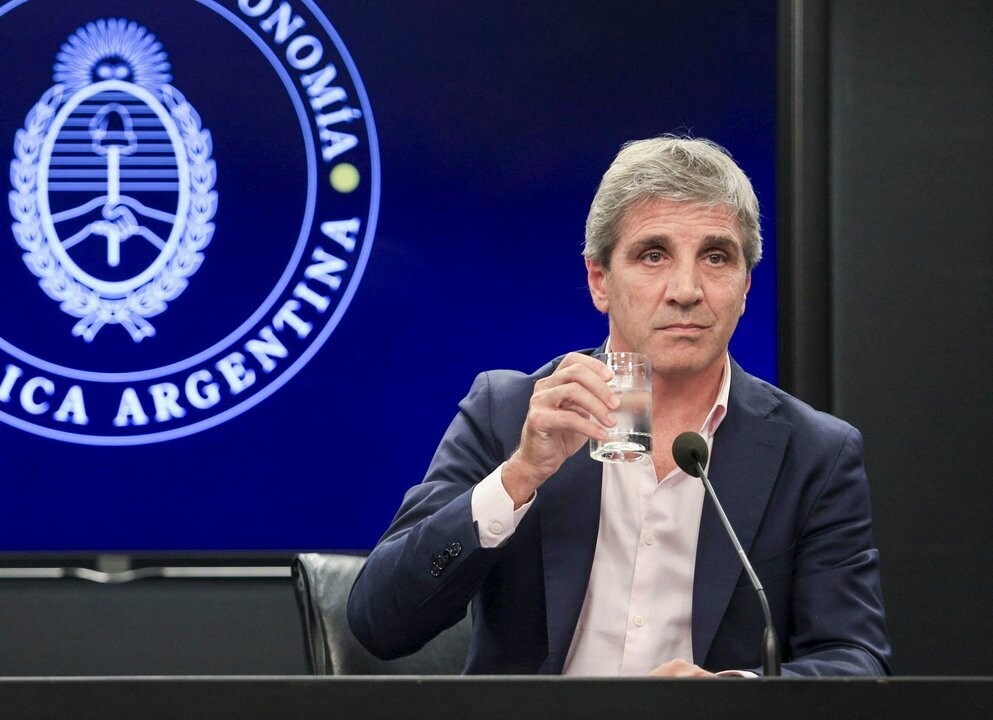
"The year-on-year growth in revenues was affected by extraordinary revenues that raised the comparison base. Among them, the moratorium in effect at that time, the shifting of deadlines for advance payments of Income Tax and Personal Property Tax for individuals corresponding to 2024, the Asset Regularization Tax and the Special Regime for Personal Property Tax Income can be mentioned," said Minister of Economy Luis Caputo.
He also compared the result of this surplus with that of the same month of 2023, during the presidency of Alberto Fernández and under the economic management of Sergio Massa.
"The financial surplus of $599,954 million contrasts with the result of November 2023, when a deficit of $754,956 million had been recorded, equivalent to almost $2,650,000 million adjusted for inflation," the report states.
At the end, he highlighted the "fiscal anchor" policy, which is "a fundamental pillar of the economic program" assumed at the beginning of the administration and that will be maintained "over time".
"The macroeconomic order has allowed protecting Argentines from the effects of the collapse in money demand generated by political volatility," he remarked.
However, the official today ruled out the possibility of an improvement for retirees due to the lack of resources to adjust benefits.
"First, the labor and tax situation must be resolved. We would love to be able to pay everyone double, but you have to have the resources," he detailed during an interview for a streaming program.
Meanwhile, compensations were $1,247,830 million (+10.1% i.a.), and contributory pensions and benefits grew 5.5% i.a.
"Primary spending fell 14.2% in real terms compared to November 2024," the report states.
This was observed, for example, in the 1.4% growth recorded by the Monthly Estimate of Economic Activity (EMAE) between July and September".